
An Array of Water Tanks in Chile Could Give the Southern Sky Its First Wide-Field Gamma-Ray View
A science-prospects paper for SWGO describes simulations of a planned baseline array of 3,763 tanks in Chile that could monitor the southern gamma-ray sky continuously from hundreds of GeV into the PeV range, forecast up to about three times more Galactic-plane sources in one year and six times in ten years, and probe PeVatron cutoffs and WIMP dark matter, subject to model assumptions.
Nov 20, 2026
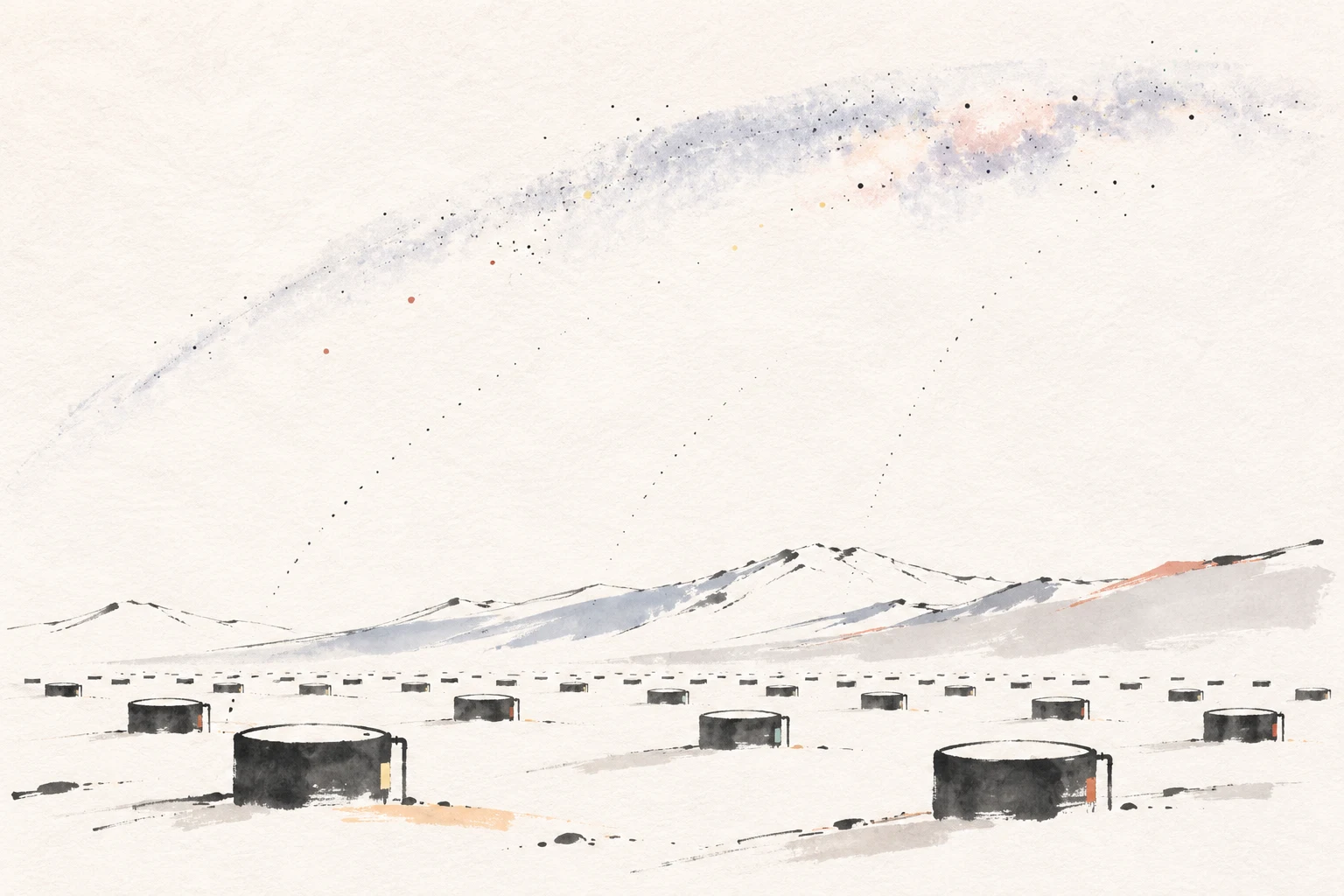
High in Chile's Atacama Astronomical Park, at 4,770 meters above sea level, the plan calls for an observatory that never points. Its baseline design is a fixed array of 3,763 water tanks. Each tank waits for the faint blue light that fast particles in a gamma-ray air shower make when they cross the water. The Southern Wide-field Gamma-ray Observatory, or SWGO, is not built yet. A science-prospects paper from the SWGO Collaboration, posted to arXiv on June 2, 2025, describes what the planned instrument could do and why the southern sky has lacked this kind of wide-field, ground-level view.
A fixed array that watches the whole overhead sky
Gamma rays are the highest-energy form of light. At TeV energies, trillions of electron volts, they can trace cosmic accelerators such as supernova remnants, pulsar winds, microquasars, and the region around the Milky Way's supermassive black hole. Ground-based astronomy uses two main approaches. Imaging atmospheric Cherenkov telescopes such as H.E.S.S. in Namibia catch blue flashes in the atmosphere. They are precise and pointed, with a narrow field of view, and work only in dark, clear conditions. Ground-level particle detectors such as HAWC in Mexico and LHAASO in China sample the particles that reach the ground. They give up some sharpness for a huge field of view and continuous operation.
Before SWGO, the northern sky has had HAWC and LHAASO. The southern sky has had H.E.S.S., which revealed rich TeV structure in the inner Galaxy but has a limited field of view and limited energy reach. No major ground-level particle-based observatory has yet operated in the south. SWGO is planned to fill that gap. The collaboration has more than 100 institutes in 17 countries and selected Pampa La Bola in northern Chile in 2024. Construction is planned in stages, starting with a small Pathfinder and then SWGO-A, a 385-tank first science-capable phase.
The baseline layout has three zones. A fill factor is the fraction of area covered by tanks. Most tanks sit in a dense central zone with a 70 percent fill factor. Two outer zones have fill factors of 4 percent and 1.7 percent and spread the array over about one square kilometer. The central tanks are dual-layer water Cherenkov detectors. The upper layer measures the electromagnetic part of a shower. The lower layer tags muons, penetrating particles from cosmic-ray showers that form a confusing background. That muon tag is central to separating gamma rays from ordinary cosmic rays.
The paper's performance numbers come from simulations of this baseline layout, not from observations. The team used air-shower simulations, reconstruction software, and machine-learning classifiers to estimate how well SWGO and SWGO-A would find gamma rays, measure their arrival directions, and reject cosmic-ray background.
A simulated survey finds 359 Galactic-plane sources in one year
SWGO stares at the whole overhead sky, so it can survey without scheduling targets. In a simulated Galactic Plane survey, using the same source-population model as a CTA Galactic Plane Survey simulation, SWGO would detect about 359 sources above the paper's detection threshold of TS > 25 in one year and 536 in ten years. The paper lists 96 sources in the H.E.S.S. Galactic Plane Survey, 48 in HAWC's 3HWC catalog, and 54 in LHAASO's first catalog. The authors describe this as up to about three times more sources in a single year and up to about six times more over ten years. The same simulation predicts that SWGO would match the CTA survey's 461 expected sources in about five years. These are forecasts. They depend on the assumed source population and on a minimal model for interstellar diffuse emission, which the paper says gives an upper estimate for detectable sources.
A 200 TeV cutoff and a WIMP window from the inner Galaxy
The Galactic Center passes directly overhead at the SWGO site, according to the paper. That is prime territory for PeVatrons, sources that accelerate particles to PeV energies, or quadrillions of electron volts. Simulations suggest the full array could detect a 200 TeV cutoff in a source's gamma-ray spectrum across a broad range of brightness and spectral hardness. The smaller SWGO-A phase would perform about 25 to 30 times worse at that task. A cutoff can hint at the maximum energy reached by protons or electrons, but it does not by itself prove which particles are being accelerated.
Dark matter is unseen mass that gravitational measurements require. One leading candidate is the weakly interacting massive particle, or WIMP. For WIMPs annihilating into bottom-quark pairs, five years of SWGO data could reach sensitivity below the thermal-relic cross-section for masses from about 800 GeV to 140 TeV. The paper calls this benchmark the thermal-relic cross-section. This estimate assumes a common Einasto profile, a model of the dark matter density, and masks the Galactic Plane to reduce astrophysical contamination. In this forecast, SWGO would be more sensitive than CTAO above about 5 TeV.
Prompt bursts and alerts in a multi-messenger sky
A fixed wide-field detector can catch events no one scheduled. The paper estimates about 0.7 gamma-ray bursts per year from externally triggered events or events with X-ray counterparts. That could rise to perhaps 1.4 per year with additional triggers from newer missions such as SVOM and Einstein Probe. In a simulated burst modeled on GRB 190114C, even rapid follow-up by CTAO's Large-Sized Telescopes missed the prompt phase. The simulation therefore leaves SWGO and SWGO-A to distinguish whether prompt TeV emission was present. SWGO would also send alerts and provide continuous coverage that pointed telescopes cannot.
What the simulations do not yet include
The forecast rests on simulations. The current setup does not include all backgrounds, such as overlapping air showers, single muons, and detector dark counts. At the highest energies, the predicted performance is conservative because very few simulated background events survive the gamma-ray selection. The machine-learning methods used for separation have been validated in cosmic-ray and neutrino work but not yet in gamma-ray astronomy. The outer array design is still being optimized. The dark matter and source-count forecasts depend on model assumptions. SWGO-A will be less capable than the full array. The paper describes planning for construction, not an operating observatory.
The southern gamma-ray sky is not empty. It has lacked a wide, continuous ground-level view. If SWGO is built, its most important discoveries may be the ones no one scheduled: an outburst, a burst, a dark matter signal, or a PeVatron caught in the act. The next step is to turn a simulated three-zone array of water tanks into a working observatory and let the southern sky speak for itself.