
Can JWST and Ariel Read a Thousand Exoplanet Skies Better Together?
A new white paper maps how JWST's sharp, targeted observations and Ariel's planned broad survey of exoplanet atmospheres could be coordinated when their operations are expected to overlap from 2030, turning complementary strengths into a joint probe of exoplanet atmospheres.
Nov 19, 2026
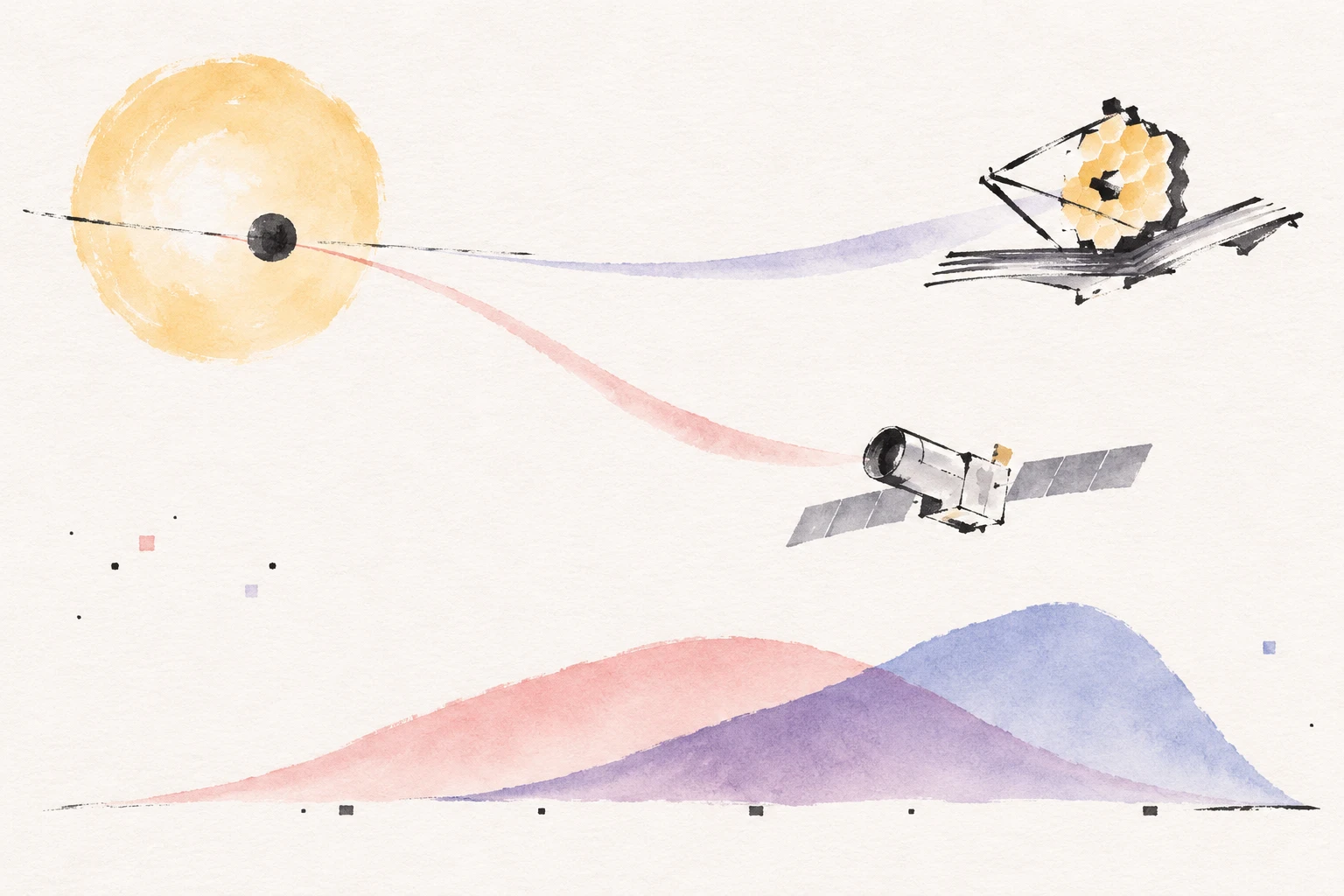
From 2030 onward, some of the most revealing views of an exoplanet atmosphere could come from two telescopes observing at the same time. The James Webb Space Telescope is already changing exoplanet science. Ariel, an ESA-led mission dedicated to surveying exoplanet atmospheres, is planned to launch in 2029. A new white paper asks how the two could cooperate rather than compete.
The paper is a planning document from the Ariel-JWST Synergy Working Group, part of the Ariel Consortium Science Team. It does not report a new observation. It maps capabilities, compares simulated spectra, and identifies ways the missions can reinforce each other when their operations are expected to overlap from 2030.
JWST is a 6.5-meter, multi-purpose infrared observatory. Exoplanet science has taken about 20 to 30 percent of its time so far. Its large mirror gives it the sensitivity to study individual atmospheres in depth. Ariel is different. It is a 1-meter-class ESA-led mission dedicated to a survey of 500 to 1,000 exoplanets over four to six years, from super-Earths to gas giants. It observes a continuous range from 0.5 to 7.8 micrometers in one shot.
Both missions read atmospheres by watching a planet pass in front of its star, a transit, or slip behind it, an eclipse. The starlight filtered through the planet's atmosphere, or the planet's own glow disappearing, carries fingerprints of molecules, clouds, and temperature.
The puzzle is not whether the telescopes overlap in wavelength. It is where each one is most efficient.
Bright stars draw the dividing line
Simulations in the paper compare a faint hot Jupiter around a star like WASP-39 with a bright one around HD 189733. For transits, stellar brightness and planet size decide the winner. For eclipses, brightness and temperature matter most. Very bright stars, with near-infrared J magnitude below about 7, can saturate JWST's detectors, meaning too much light overwhelms them. Some ideal targets are therefore hard for JWST, while Ariel can reach survey quality, called Tier 2, on them in a single observation. Faint stars reverse the problem. For stars with J magnitude above about 11, Ariel almost always needs more than ten transits to build a Tier 2 spectrum, while one JWST NIRSpec-PRISM observation, covering 0.6 to 5.3 micrometers, can already be informative.
Examples in the paper include HD 189733 b, HD 209458 b, GJ 1214 b, and 55 Cnc e as prime Ariel targets that are limited for JWST by saturation. This is not a defect in either mission. It is a natural division of labor.
A census taker and a specialist
JWST operates as a competitive observatory. Its approved exoplanet programs tend to favor unusual or extreme targets, such as the smallest, the coldest, or the highest signal-to-noise objects. Ariel is built for the opposite job, a representative survey. That difference matters because population questions require many planets, not just the easiest ones.
JWST has already begun to reveal trends. The paper notes prominent carbon dioxide features, a relative lack of methane in some hot exoplanets, and silicon-based clouds in many hot exoplanets. But understanding what drives those patterns likely requires a large sample, more than 50 objects across a wide range of stellar and planetary properties. That is the kind of sample Ariel is designed to deliver. Ariel can confirm or challenge JWST trends on hundreds of planets, while JWST can chase the exceptions.
Ariel's core survey is planned to reach about 300 to 500 targets in its first four years, with benchmark targets observed repeatedly. Its broad, simultaneous wavelength coverage is suited to snapshots of bright worlds and to phase curves, brightness measurements across an orbit that reveal hot-spot offsets, day-night contrasts, and weather. JWST can complement those phase curves by extending the wavelength range, raising the spectral resolution, or adding more challenging planet-star pairs.
A 5–7.8 micrometer bridge for simultaneous observing
A key synergy the paper explores is simultaneous observing. Ariel covers 0.5 to 7.8 micrometers. JWST's MIRI-LRS instrument can extend coverage to about 12 micrometers and probe silicate clouds around 10 micrometers. Observing at the same time could also help calibrate the two instruments and reduce confusion from changes in the star, the instrument, or the planet itself. In the paper's vision, overlapping wavelengths between 5 and 7.8 micrometers would make cross-calibration easier.
JWST also offers higher spectral resolution, up to roughly 3,000, compared with Ariel's below 150. Spectral resolution is the ability to distinguish nearby wavelengths. That sharpness can resolve individual lines of carbon monoxide, potassium, helium, and isotopes that Ariel's lower-resolution spectra may not separate cleanly. Ariel's wide view helps correct for stellar contamination and capture many molecules at once. JWST provides the zoom.
The paper is explicit about what it is, a white paper, not a detection. Its comparisons rely on simulated spectra and instrument models. Ariel's launch and the duration of any overlap with JWST remain future uncertainties. The authors also note that important gaps remain that neither mission can fill alone, and that other facilities, such as ELT, TMT, HWO, and LIFE, will be essential for a fuller picture.
Still, many coordination steps can begin before Ariel launches. JWST data are already driving upgrades to atmospheric models and data-reduction tools, and JWST trends will inform Ariel's target strategy. Ariel's survey is flexible enough to absorb those lessons. The working group argues that early coordination, joint programs, and deliberate use of each telescope's strengths would benefit the whole field.
The allure is not two telescopes doing the same thing twice. It is a partnership between a specialist and a census taker, one finding the strange cases and the other measuring how common they are. If the plan works, a thousand points of light could become a map of how planetary atmospheres are built, heated, clouded, and changed.