
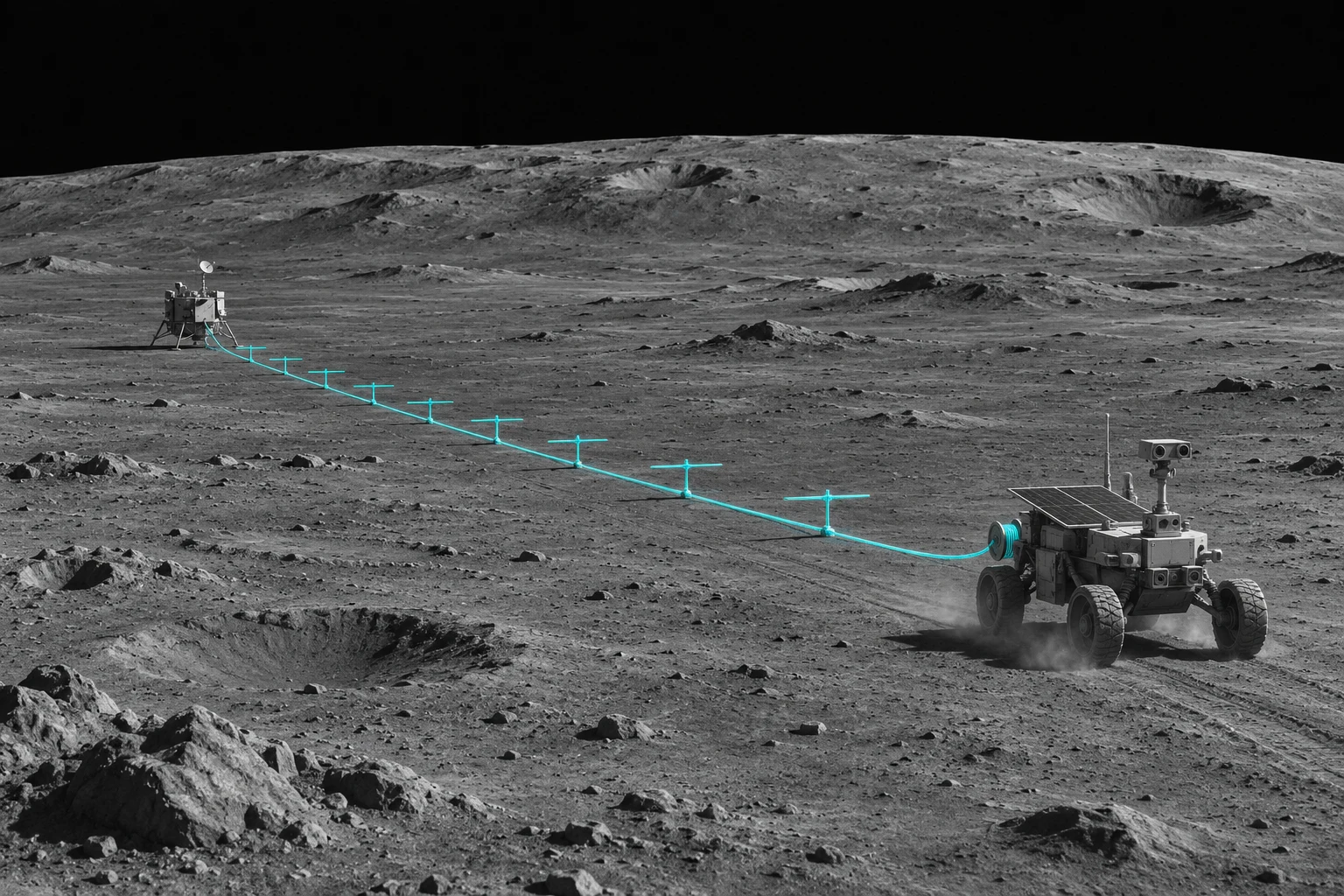
MoonRISE Concept Would Stretch Nine Radio Dipoles Across the Lunar Farside
The MoonRISE mission concept proposes a lunar-farside interferometer: nine 3.5-meter dipoles on a 1.5-kilometer fiber tether, designed to study solar-wind turbulence, the lunar ionosphere, and Uranian radio emissions from 100 kHz to 30 MHz.
Nov 26, 2026
On the lunar farside, under the MoonRISE concept, a rover would drive away from its lander and unspool a thin fiber tether across the regolith. The tether would carry nine 3.5-meter dipole antennas, each with its electronics in a small puck, and would be buried about a centimeter deep for micrometeoroid protection. The nine dipoles would form 36 interferometer baselines.
MoonRISE is a mission concept described by a team led by Saptarshi Bandyopadhyay at NASA's Jet Propulsion Laboratory. It would operate from 100 kHz to 30 MHz, including the below-20-MHz window that Earth's ionosphere and terrestrial radio interference largely block. The team argues that the lunar farside, shielded from Earth's radio chatter by the Moon itself, is the quietest radio environment in the inner solar system. If realized, the concept would be the first radio interferometer on the Moon and the first connected-element radio interferometer in space.
The concept assumes delivery by a Commercial Lunar Payload Services lander and rover. A lander-based processor would digitize and cross-correlate the dipole signals. A rover-mounted ground-penetrating radar operating from 300 to 2000 MHz would measure regolith dielectric properties and bedrock depth to help model the dipoles' radio performance. The reference landing site is Lacus Luxuriae, a farside mare region. The paper describes a concept, not a selected mission or a detection.
Why the lowest radio frequencies remain dark
The universe below about 20 MHz remains one of space science's least explored frontiers. Earth's ionosphere bends and absorbs these long radio waves, and human-made interference drowns faint cosmic signals. The band from 100 kHz to 30 MHz spans wavelengths from about 3 kilometers to 10 meters and could carry information about solar activity, planetary auroras, and the low-frequency sky.
An interferometer combines signals from separated antennas to act like a larger telescope. MoonRISE would use power-over-fiber and RF-over-fiber to keep the dipoles electromagnetically isolated from conductive lines that could add noise.
The solar wind's missing middle
One science target is the solar wind, the stream of charged particles flowing out from the Sun. Type III solar radio bursts are flashes produced by beams of electrons racing along open magnetic field lines. As those bursts travel through turbulent solar wind, radio-wave scattering changes their apparent sizes, positions, and timing. Those changes can reveal how turbulence heats and accelerates the solar wind.
Ground-based radio observations cover the region close to the Sun, below about 2 solar radii. Spacecraft measure the solar wind in situ much farther out, beyond roughly 20 solar radii. The region between 2 and 20 solar radii is poorly sampled, and it includes the zone between 4 and 7 solar radii where the slow solar wind becomes supersonic. MoonRISE would observe type III bursts in that gap. By tracking how the bursts are scattered, the team says the array could constrain the turbulence profile and where the solar wind reaches supersonic speeds. This would be a measurement of radio scattering used to infer conditions in the solar wind, not a direct probe of the plasma there.
A tenuous lunar atmosphere with real consequences
The Moon's plasma environment is another puzzle. The lunar ionosphere is extremely tenuous, but its density is uncertain by orders of magnitude. Daytime estimates range from upper limits below 10 electrons per cubic centimeter at about 100 kilometers altitude to around 10,000 electrons per cubic centimeter at a few hundred meters above the surface. In situ, theoretical, and radio-occultation estimates disagree sharply.
MoonRISE would use the dipoles themselves as plasma sensors. Below 1 MHz, the antennas would pick up quasi-thermal noise, electric-field fluctuations caused by the thermal motion of surrounding electrons. By fitting the shape of that noise, the team could extract electron density and temperature near the surface. The array would also watch for a low-frequency cutoff in radio sources, a signature of the peak density of the extended lunar ionosphere, and for scintillation caused by turbulence.
That matters beyond lunar science. Future crews and robots are expected to depend on reliable surface-to-surface communications. A variable lunar ionosphere could cause multipath propagation or distort radio signals. MoonRISE would monitor the plasma across half a lunar day, from sunrise to noon or noon to sunset, covering a full range of solar zenith angles.
Uranus, heard from the other pole
Voyager 2 discovered Uranian Kilometric Radiation during its 1986 flyby. These radio emissions are powered by energetic electrons and shaped by Uranus's magnetic field and plasma. The broad, smooth component is especially persistent and powerful. No spacecraft has observed Uranus from close range since Voyager 2, and that flyby occurred during unusually intense solar-wind conditions.
MoonRISE would observe Uranus in the opposite season from the Voyager 2 encounter, viewing the radio source from the opposite magnetic pole. The signal is faint, about three orders of magnitude below the sensitivity of a single dipole. The team proposes 60-minute integrations and stacking observations across many of Uranus's roughly 17-hour rotation periods to build up a detection.
If successful, the observations could help identify where the precipitating electrons come from. Possible sources include radiation-belt precipitation, the magnetotail plasma sheet, or interactions with a moon. That would connect Uranus's radio emissions to its magnetosphere and ionosphere, and offer context for the magnetospheres of ice-giant exoplanets.
What a concept mission can and cannot claim
MoonRISE is a design and science case, not a detection or a selected mission. The paper lays out instrument requirements, a reference landing site, launch windows, and technology maturity. The dipole electronics puck and GPR electronics are described at technology readiness level 5; the team says they would need further integration and environmental testing. The dipoles' behavior on lunar regolith has been modeled rather than tested on a true lunar surface. Uranus observations depend on long integrations. Lunar ionosphere measurements depend on models of quasi-thermal noise and assumptions about electron temperature.
The same data would also produce all-sky maps of the low-frequency sky, measurements of the farside radio environment, and subsurface structure at the landing site. Those bonus products would help future lunar radio observatories, including much larger arrays envisioned for studies of the cosmic Dark Ages.
Under the concept, a radio telescope on the lunar farside would not simply escape Earth's noise. It could turn the Moon's quiet into a new way to listen to the low-frequency universe.